Thursday, February 23, 2012

Wonderful Weather

It's a beautiful February day here in New Jersey with a high of around 60 degrees. I have actually never used "beautiful" and "February" in the same sentence because it's usually freezing with snow winding down during this time of the year! We had snow really early on October 31, which was way earlier than usual, and an inch or two during one January day. That's it. It's been pretty weird weather, but I am not complaining!
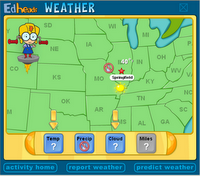
I have been using a fabulous interactive website from EdHeads that helps kids learn about weather symbols and weather maps. It has three difficulty levels and is a lot of fun! Topics covered include temperature in Celsius and Fahrenheit, cloud cover, humidity, high and low pressure, precipitation, and cold and warm fronts. More advanced students can even make predictions about how quickly a weather front will move by doing some simple multiplication.
Visit the EdHeads site by clicking here!

Download my Weather Word Wall and Bingo Game here.


Wednesday, February 22, 2012

Weather Instruments and Layers of the Atmosphere

We have been learning about the layers of the atmosphere and why each is important. We found these pictures to be especially helpful.


The atmosphere is divided into five layers. It is thickest near the surface and thins out with height until it eventually merges with space.


1) The troposphere is the first layer above the surface and contains half of the Earth's atmosphere. Weather occurs in this layer.

2) Many jet aircrafts fly in the stratosphere because it is very stable. Also, the ozone layer absorbs harmful rays from the Sun.

3) Meteors or rock fragments burn up in the mesosphere.

4) The thermosphere is a layer with auroras. It is also where the space shuttle orbits.

5) The atmosphere merges into space in the extremely thin exosphere. This is the upper limit of our atmosphere.

We wanted to know how meteorologists know what each layer is like.
The Virtual Balloon simulates a how a weather balloon is used to collect data in the atmosphere. Students can collect information on air temperature and air pressure at different altitudes in the atmosphere. We learned that the temperature can change to get colder and warmer in different layers. If you're looking for a fun but challenging activity, have your students graph the altitudes of each layer.
Make sure to click the settings button to change the number of flights per game, data samples collected per flight, and if you really feel like a challenge, change the location and season that you collect data from!

We really love the "Weather Words" song clip because it teaches all about the instruments.  

Sunday, February 19, 2012

50 Books for 50 Bucks!

I have said it before, and I'll say it again...I spend too much money on books for my classroom! After 7 years of teaching, I have been given books by students, family, friends, bought them on eBay to start my collection, got suckered by Scholastic's free $10 of books once you spend $20 and Amazon's "books we suggest," bought some using my teacher's discount at Barnes and Noble, drooled over books on Pinterest, and even gotten some from Freecycle.... and yet, I still had to buy more!
Scholastic has this great deal going on where they offer 50 books for $50! They normally retail for around $320. I had to buy both sets - for K-2 and 3-5. I figure that I'm tutoring anywhere from 6-8 kids a week, so it more than paid for it. I'll also be spending the next few months creating units for them since I haven't had time to create or add anything to my Teachers Pay Teachers account in months! Hope you take advantage of this offer before it ends on February 24! :)

Saturday, February 18, 2012

The Albertosaurus Mystery


If you have a spare hour, this video on the Badlands talks about why this area was so instrumental in preserving fossils.

If you don't have that long, check out the Badlands National Park website
It has some great Badlands videos to watch. Be sure to download the 3-5 Activity guide!

A great book to pair this with is The Night at the Museum by Milan Trenc.

Of course, you can also see the movie based on this book, A Night at the Museum.

Here's the trailer for the movie.

Want to know where you can see real dinosaur skeletons?

Visit the American Museum of Natural History in New York City! It has 2 permanent fossil halls on display. 

You can also participate in A Night at the Museum Sleepover! It's not cheap but it's a once in a lifetime experience kids will never forget!

Imagine sleeping under a whale!


....or in Middletown, New Jersey at Poricy Park!


Or if you don't live anywhere near these, click out this map

Check out my other dinosaur / fossil post "We Dig Dinosaurs" to see what I did with my science classes last year! It also lists sites where you can get more information and participate in virtual digs!

For other Journeys posts, click here.


Wednesday, February 15, 2012

Kinds of Clouds

We're learning about different kinds of clouds and how they can help meteorologists predict weather. We're going to make a "snow" mobile to help us understand what kind of clouds and where the clouds should be in the atmosphere in order for us to get snow. Until then, this should tide you over!

NASA Predicting Weather

Download this cloud type visual and question worksheet by clicking on the picture.

We used Cloudy with a Chance of Meatballs as today's speculative writing prompt and read it afterwards.

Click the picture to download the Google Doc.

Check out the movie website to play games or watch the movie trailer.

You can also check out Babbling Abby's unit which also includes The Day It Rained Hearts, which is perfect for right around Valentine's Day!

Match cloud pictures to their names!

Play the Cloud Concentration game to match different cloud types!


Check out the Enchanted Learning clouds page.

See resources for kids on the science page of my class website.