Saturday, June 11, 2011

Sunlight and Shadows

Topics covered: light, shadows, sun, and moon. 
(This goes well with the rainbow and mirror lessons I have already posted!)
Younger students can use chalk to create an outline of their feet and shadow. Redraw at one hour intervals. 
Older students can use a compass, pencil, and sunclock diagram to prove that Earth is rotating toward and away from the sun.
Print the Sun Clock Diagram here

Objectives
Students will:
  • Demonstrate that light travels in straight lines, or rays, unless it is bent or refracted. (website)
  • Explain that the sun stays relatively the same size, but may look smaller or larger depending on where Earth is in its rotation (looks bigger on the horizon).
  • Explain that the sun does not really rise, set, or disappear. Clouds can cover it or our side of the Earth may be experiencing night, so it is shining on the other side of Earth.
  • Demonstrate that the angle, intensity, and length of sunlight we get due to Earth's revolution on its axis and rotation around the sun determine which season we are experiencing.
  • Demonstrate why the moon appears to change size and shape.
  • Make a model to show that the moon does not give off its own light. Sunlight reflects off of it as well as other moons and planets, so that they can be seen.
          
Click the pictures for some great, free resources from FOSS.
Click Teacher Resources on the left, then Duplication Masters to print lab sheets.

Thursday, June 9, 2011

Mirror, Mirror on the Wall

This is a great lesson on symmetry, reflection, and light! We used mirrors and sheets from FOSS. 
We used our document camera to project what we were seeing on the big screen.
Putting a mirror above letters makes them upside down, while putting the mirror to the side makes them appear backwards.
investigating multiple reflections

Check out this BBC mirror game.

Try these!


Wednesday, June 8, 2011

Gaga for Games

Have you ever played Gaga at summer camp? My students and campers at Stonybrook Day Camp loooovvveee when we play games. It doesn't matter if they are athletic, computer, or board games, they love to play anything and everything! These games are great for recess, camp, time on a bus or in the car, or during Morning Meeting at school. I also have used some of these with the girls on the soccer team I coached - and they were teenagers!
One of my favorites is Jedi Mind Numbers. On a hot day such as today, students practice patience, teamwork, and counting as they attempt to count to a defined number (usually 10). The catch is that all eyes have to be closed and only one person can say the number at a time. You'd be surprised how much of a challenge is, and how busy it keeps them when the classroom, car, or bus are too hot for movement! Also check out these Rainy Day / Indoor Game videos on how to keep busy!

EveryDay Math incorporates tons of games into its lessons, which can be photocopied or played online during a Game Center literacy station. Spelling and vocabulary words can be turned into word searches and puzzles (Shrock Guide), flashcards (Spelling City), or games either by students or me. My students also love Sparkle, which can also be played in a car or on a bus. The Guess Who board game or question game (see video below) are also great.

Check these sites out... you (or your children, depending on computer access and ability) can create your own Jeopardy games, Who Wants to be A Millionaire, Big Wheel, etc.


Click the Game Board to Play Interactive Boggle

Click the Game Board to Play Scrabble


Monday, June 6, 2011

21st Century Skills

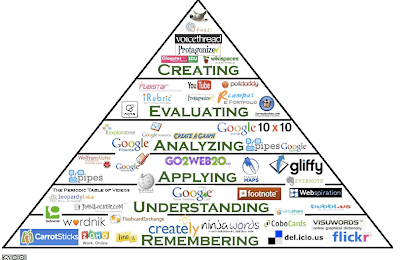
I found this neat Bloom's Taxonomy technology pyramid. Each website is listed in the category that corresponds with the skills that students use while using the site. For example, Create a Graph is listed under Analyzing. My students graph their science lab data. First they have to decide the best type of graph to use (bar, pie, line, or coordinate). Then they input the data and analyze their findings. (A student's written response to a temperature graph was, "My line graph shows that the temperature increased over time. I think this is because the air temperature was warming up because the sun was not blocked by the clouds anymore."

As you can probably tell from my previous blogs, technology is a big part of my classroom. When it goes well and everything works (I always have a backup in case it doesn't!) , we can do amazing things with kids that were unheard of when I was in school. Yes, all of the schools I went to from kindergarten on had computers, but they were the old "dinosaur" ones that required you to type in a code to get the green turtle to rotate a certain number of degrees or to turn to one side and draw a line. We had floppy disks and hard disks, and the computer paper that was connected and you had to tear off the perforated holey parts. I begged for a typewriter for my twelfth birthday, and got upset when it ran out of ink erasing fluid. I didn't have a computer at home until I was 18. My students can barely believe it.
After a discussion similar to this took place following an electricity lesson and an "elder" residency where community members met with children in specific grade levels to give them insight into what life was like when they were younger, I decided to have students complete a simple research project in which they and their partner would create a timeline showing an electrical product's development overtime. One pair chose to research a toaster oven. They found that people toasted bread using a hearth toaster, a simple metal holder for bread slices to be held over a fire. They traced all the way up to the present where we have decorative toasters that burn images into bread.
Other projects included researching our five year old Promethean Board to see what newer versions existed (The kids said we were lucky compared to people who wrote in the sand with sticks, or rubbed stone on stone, or even their classroom teachers who have chalkboards and white boards. I was jealous to find that newer boards allow two people to write with different colored pens at the same time and a touch screen version exists) and checking out phones from telegraph to the iPhone. It was a great experience, and even I learned something!

If you're reading this blog, then you are probably already pretty tech-savvy. Either way, here are some links to send you in the right direction to getting your students to meet the standards for 21st century skills.

http://web2011.discoveryeducation.com/ (tech tools and trends, all free!)

http://school.discoveryeducation.com/schrockguide/edles.html#infuse (easy ways to infuse technology into your classroom)

Sunday, June 5, 2011

Testing, Testing 1-2-3!

I know, I know. The last word a teacher or student wants to hear at the end of the year is test, but that's what most of us are doing - finishing guided reading and end of the year math assessments, grading finals, compiling writing portfolios, and giving report card grades. Let's be honest, when you hear the word assessment, you probably think test. Students learn in different ways and so we teach to different learning styles and call it differentiated instruction. But have you thought about differentiating your assessments? In my first couple of years for teaching, I always used summative and formative assessments in my classroom, but I wasn't as creative as I am now. Problem based learning and project based learning have become very popular as they are easy ways of holding your students accountable for showing what they learned without having to take a quiz or test.They can just be plain fun too!  Try involving students in creating a rubric at Rubistar.

For more detail and research on instruction and assessment, check out the What Works Clearinghouse from the U.S. Department of Education.
Check these ideas out:
http://daretodifferentiate.wikispaces.com/file/view/MeaningfulMenus.pdf
http://daretodifferentiate.wikispaces.com/file/view/tictactoe.pdf
http://daretodifferentiate.wikispaces.com/Choice+Boards (different from Picture Exhange Communication system)

Two of my favorite ways of assessing students are to have them create a foldable (upcoming blog) or a scrapbook page of what they learned. Once pages are put together, they have a memory book of the school year! I had students bring in pictures from home that had a similar theme (nature, holiday, etc.). If they forgot, I had them use PhotoBooth to take a couple of pictures. I used our school's die cuts to make it decorative. Go to freescrapbookfonts and Lettering Delights to check out their current freebies, which are perfect for scrapbooking (and blogging / worksheet creation) if you have a printer or can take screenshots. If you don't have any die cuts or a color printer, you can have the students draw with colored pencils or markers. I avoid crayons because the wax and pictures don't get along very well! Students can cut out letters, words, and phrases from newspapers or magazines too. We created borders and picture backgrounds by cutting construction paper with decorative edge scissors.


 Check out these pictures to see what my students created when I was an artist for a day at our arts festival. (I was one of the "artistic teachers" mentioned in the newspaper article.)